
YBT News
The latest news and stories from Yunbiotech.
Ankle Rehabilitation Guide After Running Injury
-
 admin
admin
-
 2025-05-28
-
 74
74
1. Why Is Ankle Rehabilitation Important?
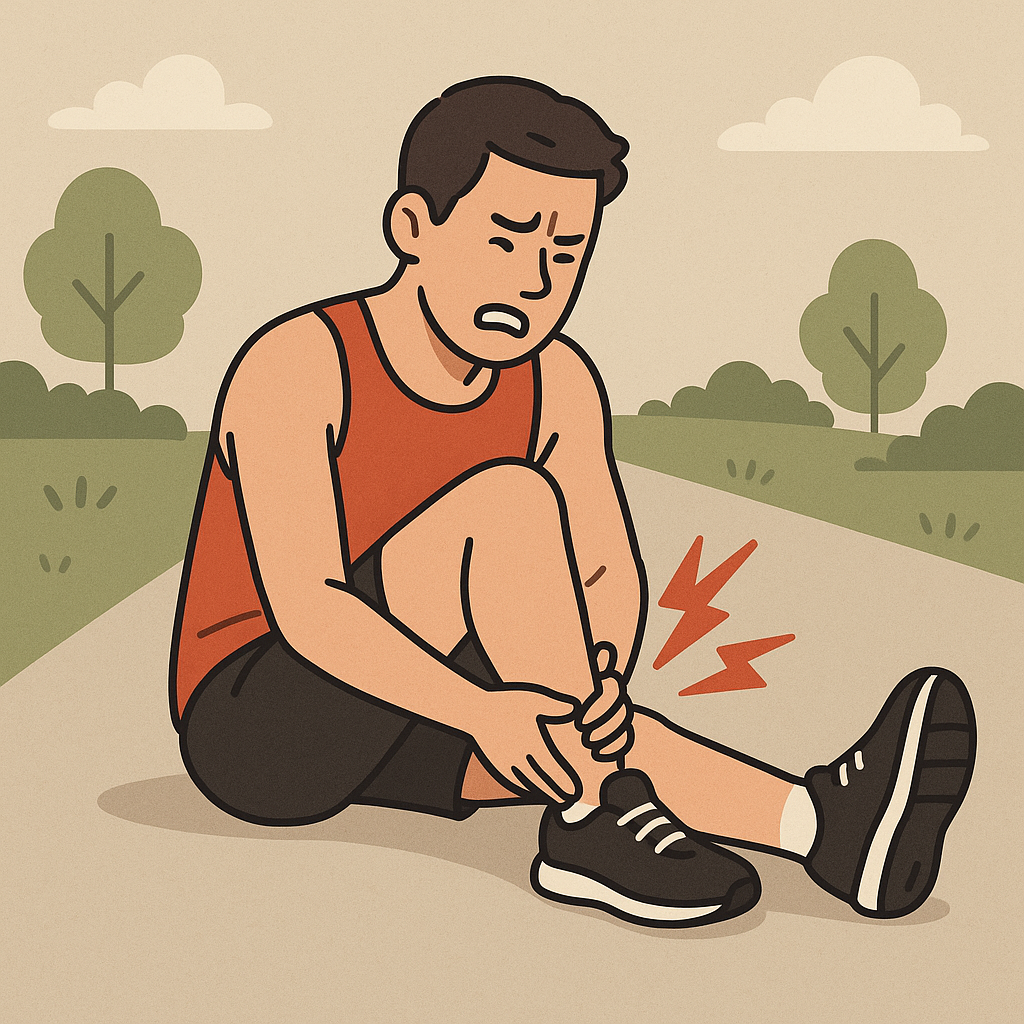
During spring, outdoor running increases, leading to a higher risk of ankle sprains and ligament injuries. After initial management (immobilization and rest), a stepwise rehabilitation program is essential to restore ankle mobility, strength, balance, and proprioception, and to prevent re-injury.
This guide provides detailed instructions, sensations, and precautions for each exercise.
2. Step-by-Step Rehabilitation Exercises with Accurate Descriptions
■ Acute Phase (1–2 weeks after injury)
Goal:- Reduce pain and swelling, and maintain basic ankle movement.
-
Ankle Pump
Position: Lie flat on your back on a mat or bed, legs straight.
Movement:- Slowly pull your toes up toward your face, so the top of your foot moves closer to your shin.
- Hold for 1–2 seconds when you feel a gentle stretch in your calf.
- Slowly point your toes away from you (downward), as if pressing a car pedal.
- Hold for 1–2 seconds when you feel a stretch in the front of your ankle.
- Repeat this up-and-down motion 10–20 times.
Caution: Stop if you feel sharp pain; do not force the movement. -
Ankle Circles
Position: Same as above.
Movement:- Lift one foot slightly off the floor (just enough so it doesn't touch).
- Draw a circle with your toes, rotating your ankle clockwise 10 times, then counterclockwise 10 times.
- Repeat with the other foot.
■ Subacute/Recovery Phase (2–6 weeks)
Goal:- Restore ankle muscle strength, balance, and proprioception.
-
Resistance Band Exercises
Position: Sit on the floor with your legs straight. Loop a resistance band around your foot and hold the ends in your hands.
Movements:- Dorsiflexion (toes up): Pull your toes up toward your face against the band's resistance, hold for 2 seconds, then slowly return.
- Plantarflexion (toes down): Point your toes away from you against the band's resistance, hold for 2 seconds, then return.
- Inversion/Eversion: Anchor the band to the inside or outside of your foot, then slowly turn your foot inward (inversion) or outward (eversion) against resistance.
Tip: Move slowly and focus on muscle contraction. -
Towel Scrunches
Position: Sit in a chair with a towel spread on the floor in front of you.
Movement:- Use your toes to scrunch and pull the towel toward you.
- Once you can do this easily, add a small weight (like a book or water bottle) on the towel.
Tip: Focus on feeling your arch and foot muscles contract. -
Calf Raise
Position: Stand holding onto a wall or railing for balance.
Movement:- With feet shoulder-width apart, slowly lift your heels to stand on your toes.
- Hold for 2 seconds as you feel your calf muscles contract.
- Slowly lower your heels back down.
- As you progress, try on one leg at a time.
■ Advanced/Strengthening Phase (after 6 weeks)
Goal:- Return to sports and regain functional strength and agility.
-
Single Leg Balance (on balance board or cushion)
Position: Stand on one leg on a balance board or thick cushion.
Movement:- Hold your balance for 10–30 seconds, gradually increasing up to 1 minute.
- For more challenge, close your eyes or raise your arms overhead.
-
Lunges, Squats, and Hops
Positions:- Lunge: Step forward and bend both knees to 90 degrees.
- Squat: Stand with feet shoulder-width apart, bend knees and hips to 90 degrees as if sitting back.
- Hop: Gently jump and land on one or both feet.
- Repeat lunges, squats, and hops to strengthen the entire lower body and improve coordination.
- Practice single-leg hops, direction changes, and jump landings to simulate real sports situations.
3. Practical Tips & Precautions
- Always perform exercises within a pain-free range.
- Focus on muscle use: Be mindful of your calf, foot, and toe muscles during movement.
- Increase difficulty gradually: Start with support (wall, railing) and progress to independent exercises.
- Frequency: 1–2 times daily, 10–15 reps per exercise, 2–3 sets; increase as tolerated.
- If pain persists or recovery is slow, consult a medical professional or physical therapist.
4. Exercise Summary Table
| Phase | Exercise | Description/Sensation |
|---|---|---|
| Acute | Ankle Pump, Circles | Slow, full range, focus on gentle stretch and relaxation |
| Subacute | Band resistance, towel scrunch, calf raise | Slow with resistance, focus on muscle contraction |
| Advanced | Single leg balance, lunge, hop | Balance, agility, coordination, sport-specific function |
5. References
- Runner’s World. Everything You Need to Know About Ankle Injuries.
https://www.runnersworld.com/health-injuries/a20865304/ankle-injuries/ - Acute Ankle Sprain Management: An Umbrella Review of Systematic Reviews.
Journal of Orthopaedic & Sports Physical Therapy, 2021
https://www.ncbi.nlm.nih.gov/pmc/articles/PMC8273319/ - Healthline: 15 Exercises for Your Sprained Ankle
https://www.healthline.com/health/fitness-exercise/sprained-ankle-exercises - Physitrack, “How to perform the Ankle Pumps”
https://www.physitrack.com/exercise-library/how-to-perform-the-ankle-pumps-exercise - PLOS ONE: Exercise-based rehabilitation reduces reinjury following acute ankle sprain
https://journals.plos.org/plosone/article?id=10.1371/journal.pone.0193417
This information is for general reference only. Always consult a healthcare professional or physical therapist for a diagnosis and personalized guidance.

