

YBT News
The latest news and stories from Yunbiotech.
Heat Generation and Risk of Low-Temperature Burns During Roll Splint Molding
-
 admin
admin
-
 2025-08-18
-
 155
155
Heat Generation and Risk of Low-Temperature Burns During Roll Splint Molding
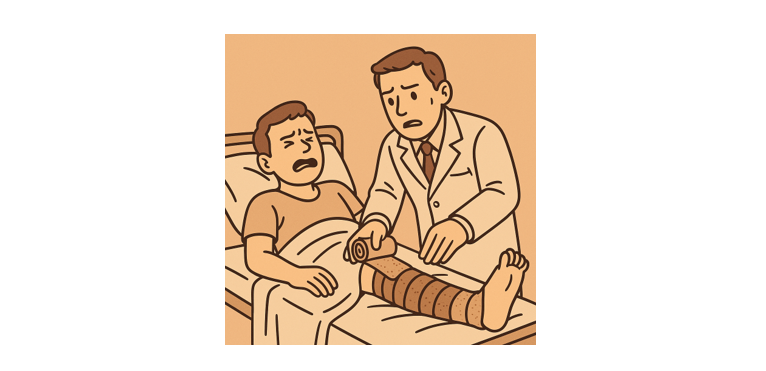
Fiberglass Roll Splint – Easy to Mold, But Is It Really Safe?
Most roll splints used in medical settings today are made from a fiberglass + petroleum-based resin structure. While they are widely used due to fast hardening and easy molding, a number of clinical reports have raised concerns about heat generation during molding and the risk of low-temperature burns.
Why Does Heat Occur? (Principle of Heat Generation)
Fiberglass roll splints undergo a curing reaction during use, which generates chemical heat. According to recent studies, the surface temperature during curing reaches an average of 47–52℃, and some products have shown peak temperatures of up to 60℃. Although this is not hot enough to immediately cause burns, constant exposure of more than 8–10 minutes on the skin can result in tissue damage. In fact, the Journal of Burn Care & Research (2018) reports that tissue protein degeneration begins when temperatures exceed 44℃ for over 6 hours, or 50℃ for more than 10 minutes.
Even the Product Manuals Warn of “Low-Temperature Burn Risk”
Most fiberglass roll splint manufacturer manuals include the following caution statements:
- Do not mold in direct contact with skin for an extended period as high temperatures may occur during curing.
- Lift and ventilate the splint 1–2 times during molding to allow excess heat to escape.
- Continuous heat exposure may cause low-temperature burns.
When Does the Risk Become Serious?
- When molding is performed directly against the patient’s skin, heat is transferred directly to the tissue.
- Continuous molding for more than 8–10 minutes results in heat buildup and tissue protein degeneration.
- Patients with swelling or reduced sensation may fail to recognize heat, delaying response and increasing injury risk.
In short, the problem is not the “heat” itself, but rather the prolonged exposure to heat while the splint is tightly attached to the skin. To safely use roll splints, it is essential to temporarily lift the splint during molding to allow heat dissipation.
References
- Journal of Burn Care & Research (2018) – Subcutaneous Tissue Damage Following Low-Grade Heat Exposure
- Journal of Orthopaedic Surgery (2020) – Heat Generation Characteristics of Glass Fiber Splints During Curing
⚠️ This information is provided for general medical education purposes only and should not be used as a substitute for professional diagnosis or treatment.
© 2025 YUNBIOTECH. All rights reserved.

