

YBT News
The latest news and stories from Yunbiotech.
Environmental Limitations of Conventional Roll Splints and the Benefits of PLA-Based STARFIX
-
 admin
admin
-
 2025-08-18
-
 123
123
Environmental Limitations of Conventional Roll Splints and the Benefits of PLA-Based STARFIX
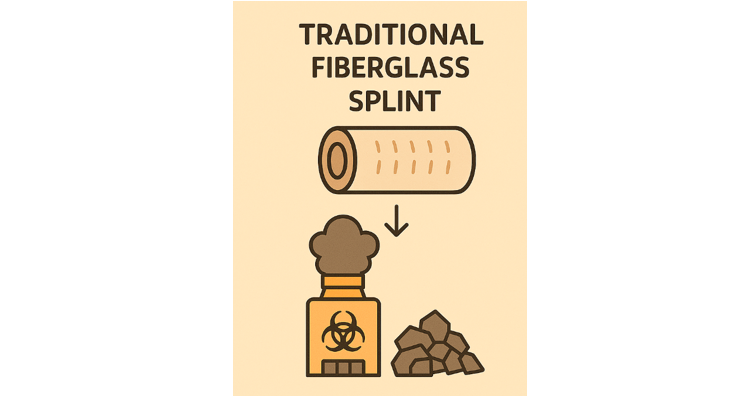
Are Conventional Roll Splints Environmentally Safe?
Most traditional roll splints currently used in hospitals are manufactured with petroleum-based epoxy resin and fiberglass. While functional in clinical use, these materials raise serious environmental concerns during disposal. In many cases, the product becomes medical waste after a short period of use and is disposed of by incineration or landfilling.
Key Environmental Issues of Fiberglass Roll Splints
- Emission of hazardous substances during incineration
Epoxy resin used in fiberglass splints may generate polycyclic aromatic hydrocarbons (PAHs) and other toxic substances when incinerated at high temperatures. - Non-combustible residues remain after incineration
Fiberglass itself is an incombustible material. Even after incineration, glass residues remain and can become fine fibers in the soil after landfill disposal. - Non-biodegradability
Petroleum-based resins are not biodegradable and may remain in the environment for several decades without decomposition.
PLA-Based STARFIX – Why It Is Environmentally Different
- 100% biodegradable PLA material
STARFIX splints use PLA (Poly Lactic Acid), a biodegradable resin made from corn-derived raw materials. PLA decomposes into water and carbon dioxide via natural microorganisms under aerobic conditions. - No toxic emissions during incineration
PLA generates almost no toxic gases such as dioxins, PAHs, NOx, or SOx when incinerated. - No incombustible residue after disposal
Unlike fiberglass, PLA leaves no residual material after combustion or degradation, reducing the burden on soil and landfill facilities.
Why This Matters
Traditional fiberglass roll splints may still function clinically, but from an environmental standpoint, they place a heavy burden on the environment at the end of their life cycle. In contrast, PLA-based STARFIX is designed to minimize environmental impact while maintaining the same or even better functionality in molding and re-forming.
In other words, the choice of splint is no longer just about “treatment”. It is also about choosing a safer direction for the environment.
References
- Environmental Toxicology and Chemistry (2022) – Emission Characteristics of Epoxy-Resin–Based Composites during Incineration
- Journal of Polymer Environment (2021) – Comparative Study on the Biodegradation of PLA and Conventional Plastics
- European Bioplastics Association – PLA Environmental Performance Report (2023)
⚠️ This article is intended for general information only and should be referenced alongside local medical-waste regulations.
© 2025 YUNBIOTECH. All rights reserved.

