


Essential Rehab: Step-by-Step Exercises to Restore a Stiff Thumb Joint
This content is intended for general informational purposes following splint removal. The appropriate timing and method of rehabilitation can vary significantly depending on the type of fracture, ligament injury depth, or whether surgery was performed. You must consult your physician before starting any rehabilitation exercises. If you experience pain, stop immediately.
Congratulations on completing your time in a thumb spica splint! However, once the splint is removed, many patients find themselves in an unexpected situation: the thumb doesn't move freely and feels stiff, almost like it belongs to someone else.
When joints and tendons are immobilized for several weeks, surrounding tissues can become adherent and muscles weaken. Forcing movement too quickly can lead to re-injury, so gradual and structured rehabilitation is essential to safely restore joint function.
Phase 1: Passive Range of Motion (ROM) – Gently Reintroducing Movement
In the early stage after splint removal, the thumb is usually too weak to move effectively on its own. Use your opposite hand to assist gentle movements without applying force to the painful thumb.
- Thumb extension stretch: Use your opposite hand to gently pull the affected thumb outward (backward) within a pain-free range. Hold for 5–10 seconds, then release.
- Joint bending: Lightly hold the middle and base joints of the thumb and gently bend them inward using your other hand.
Key principle for Phase 1: Move only to the threshold of "mild discomfort." Never force or push through pain.
Phase 2: Active Range of Motion (ROM) – Regaining Control
This stage focuses on restoring movement using only the thumb's own muscle strength, without assistance from the other hand. This helps tendons glide smoothly again.
① Finger Opposition
Touch the tip of your thumb to the tip of your index finger to form an "O" shape. Then sequentially touch the thumb to the middle, ring, and little fingers. Repeat 5 times in both directions.
② Palm Crossing
With your palm open, move your thumb across the palm toward the base of the little finger as if touching it. Hold for 3 seconds at the end range, then return to the starting position.
Phase 3: Light Resistance Exercises – Strengthening the Thumb
Once joint motion improves to near-normal and daily activities are pain-free, you may begin light strengthening with your physician's approval.
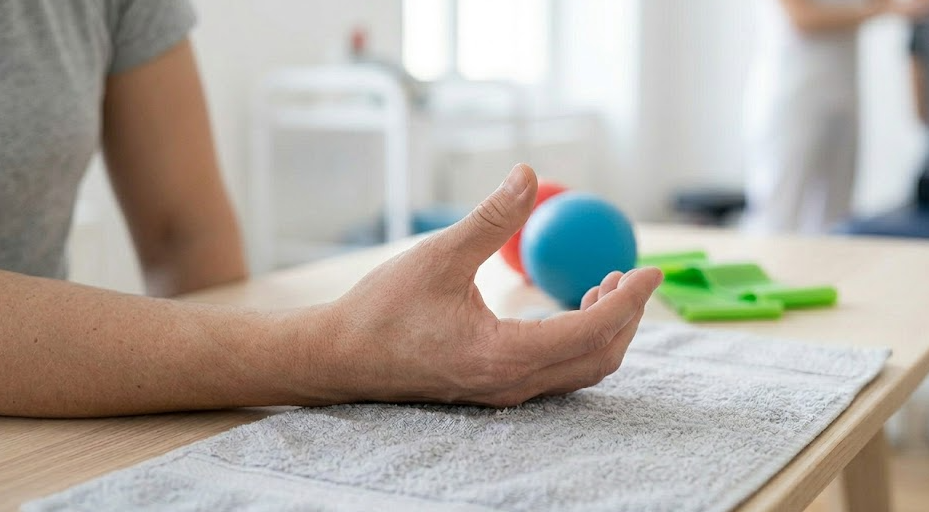
- Soft ball squeeze: Hold a soft stress ball or rubber ball in your palm and gently squeeze using the thumb and other fingers. This builds gripping strength.
- Rubber band expansion: Place a rubber band around all fingers and move your thumb outward against the resistance. This strengthens thumb abduction and the abductor muscles.
Stop Exercising Immediately If You Experience These Symptoms
Rehabilitation should not cause harm. If you notice any of the following signs during or after exercise, your joint or tendon is under excessive stress:
- Sharp, stabbing pain: Not a dull ache but sharp pain may indicate inflammation or micro-injury.
- Persistent swelling or warmth after exercise: If your thumb remains swollen and warm hours after exercise, apply ice immediately and reduce exercise intensity.
This step-by-step rehabilitation guide is based on international standards for hand rehabilitation and orthopedic protocols:
- • American Academy of Orthopaedic Surgeons (AAOS): Hand and Wrist Rehabilitation Exercise Guide
- • American Society of Hand Therapists (ASHT): Patient Education & Splint/Post-Splint Protocols
- • Johns Hopkins Medicine: Rehabilitation guidelines for tendonitis and ligament injuries
[Disclaimer]
This rehabilitation content is based on general health knowledge and does not replace professional medical diagnosis or advice. Recovery varies significantly by individual. For safe and healthy recovery, you must consult a qualified physician before beginning any rehabilitation program. We are not responsible for any issues arising from improper use of this information. Please use this content for reference only.

